
Notes from the Show
Snippets of Interviews of Fictional Karaoke MCs

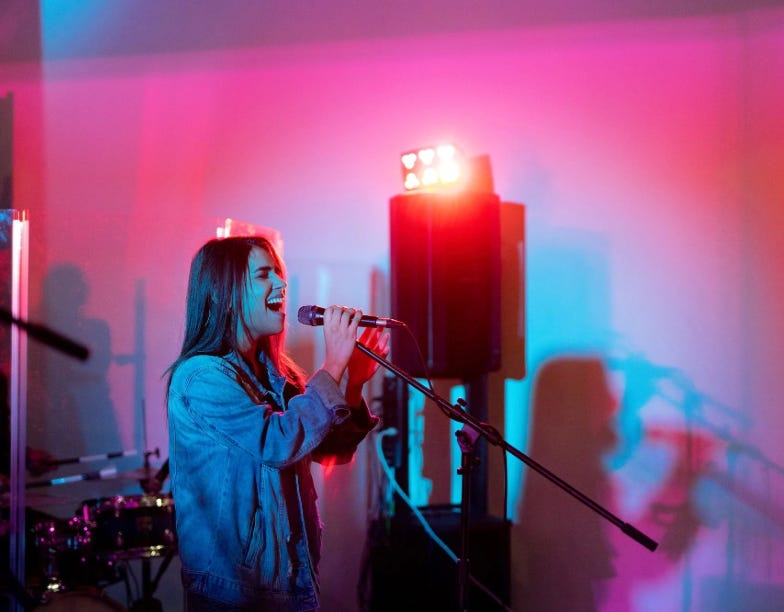
They all insist on calling it “the Show,” with the capital S doing a lot of unpaid labor.
“I’m not a DJ,” one of them tells me, before I’ve asked anything. “I’m a facilitator of courage.” He says this while untangling three identical aux cords, each of which he claims is “the good one.” His name is Trevor or Travis. He wears a lanyard with nothing on it.
—
A woman named Denise keeps a laminated list titled Songs That Ruin the Night. It includes “Bohemian Rhapsody,” “Sweet Caroline,” and, somewhat controversially, “Mr. Brightside.” Not because they’re bad, she clarifies, but because they create a temporary monoculture.
“After the first ‘BAH BAH BAH,’” she says, “you don’t have a room anymore. You have a regime.”
—
Another KJ, Luis, describes the rotation as “a moral document.”
“You think it’s just a list,” he says. “It’s not. It’s a statement about fairness, about patience, about whether the guy who tipped you five bucks gets to jump ahead of the woman who’s been waiting forty minutes to do Before He Cheats.”
He pauses.
“He does, by the way. I’m not proud of it, but he does.”
—
There is a near-universal hatred of duets where only one person knows the song.
“Duets are lies,” says Marcy, who runs a weeknight show in a bowling alley that smells faintly like cinnamon disinfectant. “They’re aspirational. They assume a level of relational symmetry that rarely exists.”
—
One KJ, who asks not to be named, claims there is a coordinated effort by what he calls “Big Karaoke” to phase out certain tracks.
“You ever notice how it’s harder to find older versions of I Want It That Way?” he asks. “They want you on the new mixes. The ones with the crowd noise baked in. It conditions you.”
“Conditions me for what?”
He shrugs. “Compliance.”
—
Several mention the same phenomenon: the sudden, inexplicable silence right before someone starts a song they absolutely should not have chosen.
“It’s like the room knows,” Denise says. “Like there’s a collective intake of breath.”
—
Ambition varies.
“I want to franchise,” Trevor-or-Travis says. “Standardize the experience. Same lighting cues, same intro patter. You walk into any bar in America, you know exactly how the Show is going to feel.”
He describes this as “comforting.”
—
Marcy says she wants out.
“I used to think this was a stepping stone to something,” she says. “Now I think it might be the thing. Which is worse.”
—
One KJ talks about the moment someone crosses over from ironic to sincere mid-song.
“It’s visible,” he says. “There’s a facial shift. They start out doing a bit, and then suddenly they’re inside it. It’s the only real thing that happens all night.”
—
A younger host, Kevin, keeps stats.
“I track key changes, average song length, applause duration. I have a spreadsheet.”
“Why?”
“I think there’s a pattern,” he says. “Not in the songs. In the people.”
He won’t elaborate.
—
And then there’s Alina, who, when asked about the Show, just tells me about a dream she had.
“In the dream, the stage is infinite,” she says. “Not big. Infinite. Like it keeps going past the walls, past the parking lot, into something that isn’t a place.”
“There’s no screen. You already know the lyrics, even the ones you don’t know. Everyone is waiting, but there’s no order. No rotation. You don’t get called. You just… arrive at the mic when it’s your turn, but you don’t know how you know it’s your turn.”
She looks at her hands like they might be holding something.
“And when you sing, it’s not your voice. It’s like the room is singing through you. Not louder. Just more correct.”
“What song?” I ask.
She thinks about it.
“All of them,” she says. “At the same time. But it wasn’t noise. It made sense.”
—
Back in the waking world, someone queues up “Don’t Stop Believin’,” and there’s that brief, shared pause before the first piano notes.
The Show continues, which is, depending on who you ask, either the problem or the point.