
The Ruth Asawa Plot Twist: When Limitations Aren’t

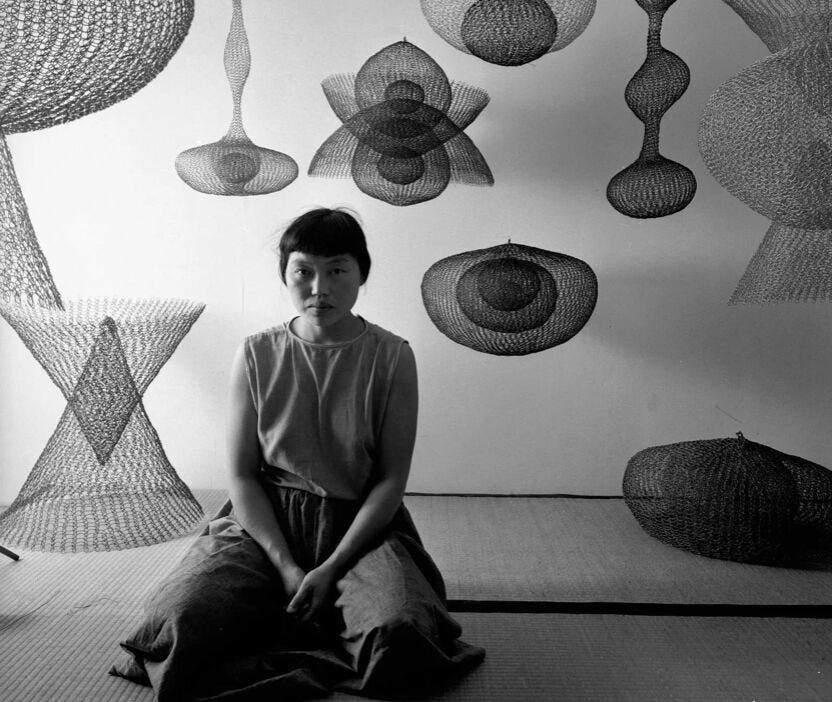
Some of the most radical artists didn’t come from freedom—they came from restriction. Ruth Asawa is one of them. She turned industrial wire—hardware store wire—into floating, translucent sculptures that bent the definition of sculpture itself. And she did it while the country around her tried to tell her where she didn’t belong.
At 16, she was sent to an internment camp because her parents were Japanese immigrants. Her education was disrupted. Her dream of becoming an art teacher was quietly buried—racial discrimination kept her from completing the required student teaching. The few doors that were open slammed shut again once people saw her face.
And yet: she made. With wire. Not because it was fashionable, but because it was available. Copper, brass, galvanized steel—the kind of materials no one thought to make art from, let alone art that would one day hang in MoMA. She learned looping techniques from Mexican basket makers on a trip to Oaxaca, then used them to construct organic, open-lattice forms that hovered in space—less like traditional sculpture, more like air with intent.
The art world didn’t quite know what to do with it. They tried calling it “decorative,” a term long used to sideline the work of women and artists of color. But Asawa’s pieces refused containment. They weren’t small, safe, or supplemental. They altered the room. They made viewers stop and recalibrate their sense of volume, space, and structure.
Her time at Black Mountain College, under thinkers like Josef Albers and Buckminster Fuller, helped sharpen her formal instincts. But the deeper thread wasn’t academic—it was necessity. She couldn’t get her hands on bronze, so she used what was around. And what she built with it was singular. Elegant. Strange. Essential.
She didn’t just persevere despite limitation—she built her language through it. That’s not a bootstrap myth. It’s a working method. Constraint was not the obstacle. It was the form.
And she didn’t stop at galleries. Her public fountains still shape San Francisco, and she co-founded the School of the Arts there to give future generations access to the education she’d been denied.
Her legacy isn’t just in museums. It’s in what she proved: you don’t need permission. You need vision, a little wire, and the stubbornness to keep weaving. #creativity #art #ruthasawa