
What good is the 25th Amendment?
We're never going to use it. We don't have the character to try.

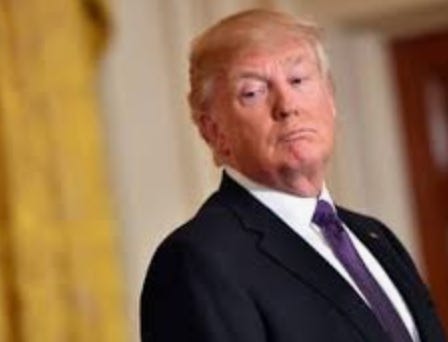
You don’t even have to say his name anymore.
That’s the tell. Not the speeches, not the footage, not the slow drift from coherence into something more feral and unbound. The tell is that reference has collapsed. A pronoun does the work now. A gesture in the general direction of the television. Everyone understands. No one needs clarification.
We have arrived at the point where recognition is ambient but action is impossible.
The 25th Amendment sits there in the Constitution like a fire axe behind glass—clean, labeled, theoretically available. A mechanism for moments exactly like this one: when a president becomes unable, unwilling, or simply unmoored from the basic requirements of the office. It was designed in the shadow of mid-century fragility, when the state still imagined itself as something that could be stabilized by procedure, by consensus, by a shared interest in continuity.
But the amendment assumes a thing that no longer exists: a governing class that believes in governance.
To invoke it requires coordination, risk, and a willingness to end careers. It requires people inside the system to act against the system’s immediate incentives in order to preserve its long-term viability. It requires a cabinet that sees itself not as a collection of individual brands, but as custodians of something larger and more fragile.
That’s the missing piece. Not law. Not precedent. Not even evidence.
Custodianship.
What we have instead is a landscape of careerists and self-dealers, people whose primary skill is survival within the machine as it is, not intervention when it breaks. The incentives run in one direction: protect your position, maintain access, avoid being the one who moves first. The cost of action is immediate and personal. The cost of inaction is diffuse, delayed, and shared by millions of people who have no leverage over the decision.
So nothing happens.
Everyone waits for someone else to absorb the blast radius. Everyone tells themselves that maybe it’s not quite at the threshold yet, that maybe one more week, one more cycle, one more scandal will clarify things. Meanwhile, the baseline shifts. What would have been disqualifying becomes normal. What would have triggered panic becomes content.
And the amendment remains behind the glass.
There’s a deeper discomfort here, one that goes beyond any single presidency. The 25th Amendment is part of a broader American habit: building procedural solutions to moral problems. We draft mechanisms and believe, or pretend to believe, that their existence is enough. That the presence of a rule implies its use. That the architecture will hold even if the people inside it decide not to carry its weight.
But procedures don’t enforce themselves. They’re inert without will.
If anything, they can become a kind of alibi. Proof that we could act, which slowly mutates into a reason we don’t have to. The system contains the answer, so the failure must be elsewhere—timing, optics, politics. Never the simple fact that no one is willing to pull the lever.
There’s also the matter of cruelty, which has become strangely normalized as a governing posture. Not just cruelty in the obvious sense—policy that harms, rhetoric that dehumanizes—but a colder, more ambient form. Indifference. The willingness to let damage accumulate because addressing it would be inconvenient or destabilizing.
We punish almost nothing now. Not greed, not laziness, not bad faith, or the lack of curiosity. The incentives all run toward extraction: take what you can, hold your position, let the consequences fall outward. In that environment, the idea of removing a sitting president for incapacity feels almost quaint. It implies a baseline of responsibility that the system has already abandoned in practice.
And so the spectacle continues.
An increasingly unstable figure at the center, surrounded by people who know, or at least sense, what’s happening, and a public that oscillates between outrage and exhaustion. The machinery of state still moves—budgets get passed, statements get issued, operations continue abroad—but it feels less like governance and more like inertia. A large object drifting forward because no one has figured out how, or whether, to steer.
If the 25th Amendment means anything, it means that at some point, someone inside the system decides that continuity is less important than intervention. That the cost of acting is lower than the cost of pretending everything is fine.
We’re not there.
And maybe that’s the real diagnosis—not of a single man, but of the structure around him. The inability to act even when the need is obvious. The preference for slow decay over abrupt correction. The quiet calculation that it’s better to let things break in motion than to be the one who stops them.
The amendment isn’t enough because nothing is enough without people willing to use it.
Until that changes, it stays where it is: visible, legible, and effectively meaningless.
Beautiful reasoning. Horrific in its implication. Why does the prospect of removing this creature seem so remote in comparison to Nixon, who's crimes were so minor in comparison? Although our failure to prosecute in that case plays into your argument.
SPOT. ON. Thank you for this. Publish.